
Blau. (2016). ¿ LIGO spots a second
gravitational wave? . Pasadena: Ligo
caltech. Recuperado de https://physicstoday.scitation.org/do/10.1063/PT.5.7276/full/
Castañeda,
L. (2018). Gravitational Waves: From Your Prediction to the Nobel Laureates.
Moment: Journal of Physics, 56, 1–6. http://web.b.ebscohost.com.cidreb.uned.ac.cr/ehost/pdfviewer/pdfviewer?vid=12&sid=bbbd5d45-af9d-4867-ba1d-bbbe2e1d5e43%40pdc-v-sessmgr01
LIGO Caltech. (s.f). Laser Interferometer
Gravitational-Wave Observatory. Recuperado de https://www.ligo.caltech.edu/
Manreza, P, D., &
Pérez, M, A. (2017). Space-Time Waves: The
2017 Nobel Prize in Physics. Cuban Journal of Physics, 34(2), 172–178 http://web.a.ebscohost.com.cidreb.uned.ac.cr/ehost/pdfviewer/pdfviewer?vid=13&sid=b558074c-fcfc-4320-8ff7-157627520caf%40sdc-v-sessmgr02
NASA. (s.f). ¿What are gravitational
waves?. Pasadena: Ligo caltech. Recuperado
de https://www.ligo.caltech.edu/page/what-are-gw
Referencias de imágenes
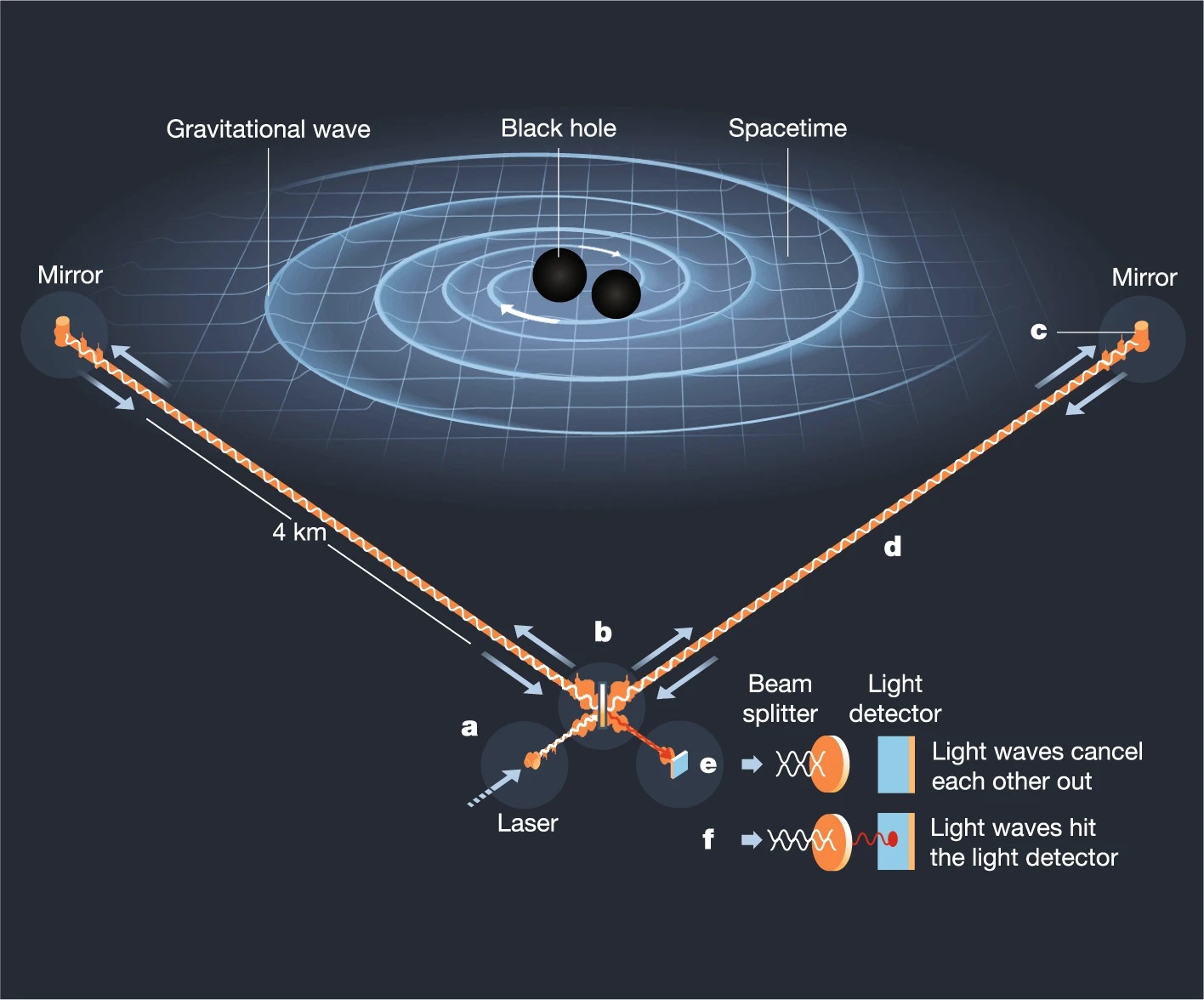
Enlace imagen 1: LIGO https://serviastro.ub.edu/sites/serviastro/files/inline-images/41586_2019_1129_Fig1_HTML.jpg
Enlace imagen 2: LISA (Laser-Interferometer Space Antenna)
Comentarios
Publicar un comentario